

When your child receives an autism diagnosis, the term “ABA therapy” shows up everywhere. Pediatricians recommend it. Online parent groups discuss it. Insurance covers it. But if you’re like most families, you’re still wondering: what actually happens behind those clinic doors?
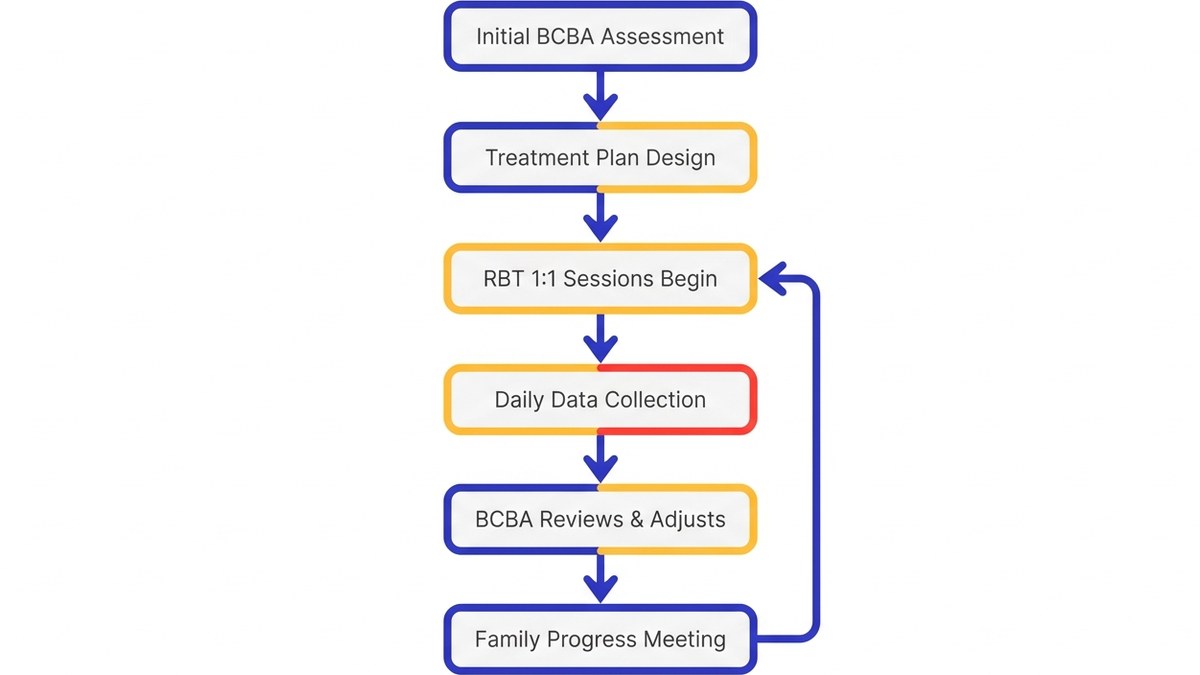
ABA therapy works through a structured, individualized process: a Board Certified Behavior Analyst (BCBA) assesses your child’s skills and challenges, designs a personalized treatment plan, and supervises Registered Behavior Technicians (RBTs) who deliver one-on-one therapy sessions. Each session uses evidence-based techniques like positive reinforcement and naturalistic teaching to build communication, social, and daily-living skills. Progress is tracked daily, and the BCBA adjusts the plan based on data to ensure meaningful, measurable growth.
This guide walks you through every step of the ABA process, from the first phone call to ongoing progress tracking. You’ll see what happens in a session, understand your role as a partner, and learn how the pieces fit together to create the benefits families can expect from ABA therapy. No jargon. No mystery. Just the real process that thousands of Arizona families have walked before you.
What Is ABA Therapy? (A Quick Foundation)
ABA stands for Applied Behavior Analysis, a science rooted in how people learn. The methodology examines which behaviors help a child thrive (communication, social skills, daily living tasks) and which behaviors create barriers (tantrums, self-injury, refusal). Then it uses evidence-based teaching methods to increase helpful behaviors and reduce challenging ones.
This isn’t a one-size-fits-all protocol. Every ABA program is individualized. The BCBA observes your child, interviews your family, and builds goals around what matters most to you: helping your child ask for what they need, play with peers, tolerate new foods, or transition to school independently.
According to the Autism Science Foundation’s statement on ABA, ABA is the most researched and validated intervention for autism, endorsed by major medical and autism organizations. Decades of studies show that intensive, individualized ABA can produce meaningful gains in language, adaptive skills, and social functioning. The key word is individualized. Your child’s program will look different from the child in the next session room because their starting points, strengths, and family priorities are unique.
If you’re still exploring what ABA means in practice, our parent’s guide to ABA therapy fundamentals walks through the basics in plain language. For now, understand this: ABA isn’t a mystery. It’s a structured, transparent process, and you’ll be a partner at every step.
Step 1: The Initial BCBA Assessment
The ABA journey begins with a comprehensive assessment, typically two to four hours long, conducted by a Board Certified Behavior Analyst. The BCBA is the clinical expert who will design your child’s treatment plan and oversee their entire program. Think of them as the architect: they blueprint the program, supervise the team, and adjust the plan as your child grows.
During the assessment, the BCBA observes your child in natural play and structured tasks. They watch how your child communicates (words, gestures, pointing), how they engage with toys, how they respond to changes in routine, and how they regulate emotions when frustrated. This isn’t a test your child passes or fails. According to the CDC’s guidance on autism diagnosis and evaluation, it’s a snapshot of their current skills across multiple domains: communication, social interaction, daily living (self-care, feeding, toileting), play skills, and emotional regulation.
Just as importantly, the BCBA interviews you. What are your biggest worries? What does a good day look like? What skills would change your family’s life if your child mastered them? Maybe it’s using words instead of screaming. Maybe it’s tolerating a haircut. Maybe it’s playing independently for ten minutes so you can make dinner. These priorities become the foundation of your child’s goals.
The assessment also identifies your child’s strengths. Does your child love music? Do they have strong visual memory? Do they calm down with sensory input like swinging? The BCBA uses these strengths as teaching tools. ABA works best when it meets a child where they are and builds from their interests, not against them.
If you’re curious about the clinical expertise behind this step, the BCBA’s role in designing treatment plans explains what credentials, training, and supervision standards ensure quality care. At Arizona Autism Clinic, every BCBA maintains continuous oversight of their caseload, not quarterly check-ins. That distinction matters when your child’s progress depends on real-time adjustments.
The assessment typically happens in the clinic, but some BCBAs also observe the child at home or in the community to see how skills generalize across settings. By the end, the BCBA has a clear picture: where your child is today, where you want them to go, and the roadmap to get there.

Step 2: Building the Individualized Treatment Plan
Once the assessment is complete, the BCBA designs the treatment plan. This is the blueprint for your child’s therapy: the specific skills they’ll learn, how those skills will be taught, and how progress will be measured.
Goals are written in measurable, observable language. According to behavior analysis methodology outlined by the Association for Behavior Analysis International, precision in goal-writing allows clinicians to track progress objectively. For example, a communication goal might read “request preferred items using a two-word phrase with 80% independence across three consecutive sessions.” A transition goal might read “tolerate transitions between activities without protest in 70% of opportunities over one week.” This precision allows everyone on the team (the BCBA, the RBTs, and you) to see whether the intervention is working.
Goals span multiple domains:
- Communication: requesting, labeling, answering questions, conversational skills, using augmentative communication (AAC) devices if needed.
- Social skills: turn-taking, joint attention, sharing, greeting peers, understanding emotions.
- Daily living: self-feeding, toilet training, dressing, hygiene, safety awareness (not running into streets, staying with caregivers in public).
- Emotional regulation: tolerating “no,” managing frustration, using calming strategies, recognizing and naming emotions.
- Play and leisure: engaging with toys functionally, pretend play, following game rules, tolerating sensory activities (swings, water play).
These goals aren’t pulled from a template. They reflect your priorities. At Arizona Autism Clinic, every treatment plan is reviewed monthly with families to ensure goals still align with real-world priorities. If your child masters a skill or a new challenge emerges (a new sibling, a school transition, a medical procedure), the plan adjusts. ABA is dynamic, not static.
The plan also outlines the teaching methods the RBTs will use: discrete trial training for foundational skills, naturalistic teaching for communication in play, task analysis for self-care routines, visual supports for transitions. The BCBA tailors the methods to your child’s learning style. A child who thrives on structure might start with discrete trial training, while a child who resists table work might respond better to play-based, naturalistic instruction from day one.
You’ll receive a written summary of the treatment plan, and the BCBA will walk you through it in a family meeting. This is your chance to ask questions, voice concerns, and clarify expectations. Understanding how ABA therapy works helps families feel invested in the outcomes and confident in the process.
Step 3: What Happens in a Therapy Session
Now the plan moves from paper to action. Your child begins working with a Registered Behavior Technician (RBT), the frontline therapist who delivers the one-on-one instruction. At Arizona Autism Clinic, your child gets True 1:1 care: one dedicated technician’s full attention for the entire session, every session. No shared time with another client. No rotating staff mid-session. This consistency builds trust, accelerates learning, and allows the RBT to respond instantly to your child’s needs.
So what does a session actually look like? Forget the stereotype of a child sitting at a table for three hours. Modern ABA is play-based, naturalistic, and flexible. Here’s what you might see:
Play-based learning: The RBT sits on the floor with your child, playing with blocks. As your child reaches for the blue block, the RBT prompts, “Say ‘blue block.'” Your child says “blue,” and the RBT immediately hands over the block with praise: “Great job saying blue!” This is naturalistic teaching, where learning happens in the context of play and the child’s own interests drive the lesson.
Discrete trial training (DTT): For certain foundational skills (matching, labeling, following instructions), the RBT uses short, structured teaching intervals. They present a clear instruction (“Touch nose”), prompt if needed, and immediately reinforce correct responses with praise, a high-five, or a small preferred item (a sticker, a few seconds with a favorite toy). Trials are quick (5 to 10 seconds each), repeated multiple times, and interspersed with breaks and preferred activities so the child stays engaged.
Sensory breaks: Halfway through the session, your child gets fidgety. The RBT takes them to the sensory room for five minutes on the swing. This isn’t wasted time. It’s regulation. A calm, regulated child learns better. The break is built into the plan.
Community outings: If a goal is “follow caregiver in public settings,” the RBT might take your child to a grocery store, practicing staying close, using an indoor voice, and tolerating the sensory input (bright lights, crowded aisles). Generalization, the ability to use skills in real-world settings, is a core ABA principle. Skills learned at a table in a clinic don’t help much if a child can’t use them at the park or the dentist’s office.
Positive reinforcement is everywhere: When your child completes a task, attempts a hard skill, or uses a replacement behavior instead of a tantrum, the RBT reinforces it immediately. Reinforcement can be social (praise, tickles, high-fives), tangible (a small toy, a snack), or activity-based (two minutes with a preferred video). The key is timing: reinforcement happens within seconds of the desired behavior so the child connects the two.
Research published in PMC (PubMed Central) demonstrates that ABA interventions using positive reinforcement and individualized teaching strategies produce significant improvements in adaptive behavior, communication, and social skills for children with autism. The evidence base is decades deep.
Sessions typically run two to four hours at a time, multiple days per week. Intensity varies based on the child’s age, needs, and insurance authorization. Younger children often receive 20 to 40 hours per week of therapy; older children or teens might receive fewer hours focused on specific skill gaps.
For families with older children, ABA programs for teens and young adults look different. Sessions might focus on job skills, self-advocacy, managing a schedule, or navigating social situations. The principles stay the same (individualized, data-driven, BCBA-supervised), but the goals and settings shift to match developmental stage.

Step 4: Daily Data Collection and Progress Tracking
Here’s what separates ABA from other therapies: everything is measured. Every session, the RBT records data on every goal. Did your child request a snack using words? Data point. Did they tolerate a transition without protest? Data point. Did they accurately complete color-matching tasks? Recorded.
This isn’t busywork. Data drives every decision the BCBA makes. According to research published in the Journal of Applied Behavior Analysis, systematic data collection allows clinicians to make objective decisions about treatment effectiveness and adjust interventions in real time. If a child isn’t progressing on a goal after two weeks of consistent teaching, the BCBA sees it in the data and adjusts the teaching method, the prompt level, or the reinforcement strategy. If a child masters a goal faster than expected, the BCBA sees that too and advances to the next skill.
Data collection happens in real time, often on a tablet or laptop. The RBT marks correct responses, errors, prompts given, and behaviors observed. At the end of each session, the data uploads to a central system where the BCBA reviews it.
Families aren’t left in the dark. At Arizona Autism Clinic, families receive daily progress updates, not quarterly reports. You can log in and see how your child performed that day: which goals they worked on, how many trials they completed, and what the RBT noted about their mood, attention, or new emerging skills. This transparency builds trust and allows you to reinforce the same skills at home.
Without data, therapy becomes guesswork. With data, it becomes science. You’ll see trends emerge: your child’s attention span improves after sensory breaks, or they learn faster in the morning than the afternoon, or a specific prompt style clicks for them. The BCBA uses these patterns to fine-tune the program continuously.
Families choosing an ABA provider should ask about data transparency, progress reporting frequency, and how families access their child’s records. These are quality indicators that separate excellent programs from mediocre ones.
Step 5: Ongoing BCBA Supervision and Plan Adjustments
The BCBA doesn’t design the plan and disappear. Supervision is continuous. The BCBA observes live sessions (in person or via video), reviews data weekly, coaches RBTs on teaching techniques, and adjusts goals as the child progresses.
Supervision frequency varies by state regulations and the child’s complexity, but best-practice programs maintain weekly or biweekly BCBA oversight. At Arizona Autism Clinic, our BCBA-to-client supervision ratio ensures continuous oversight, not quarterly check-ins. The BCBA is present, accessible, and responsive.
What does supervision look like in action? The BCBA watches the RBT run a teaching session. They notice the child isn’t responding to a verbal prompt, so they coach the RBT to add a visual cue. Immediately, the child’s accuracy improves. The BCBA updates the protocol, and the RBT uses the visual cue going forward. That’s real-time, data-informed adjustment.
As your child masters goals, the BCBA introduces new ones. As behaviors improve, intensity might decrease. As your child prepares for school, goals shift toward classroom readiness (sitting in a group, following multi-step directions, raising a hand to ask for help). The plan is never static. It evolves with your child.
This level of oversight is what separates high-quality ABA programs from mediocre ones. When choosing a provider, ask about BCBA supervision hours, caseload size, and how often the BCBA directly observes your child. If the answer is vague or infrequent, that’s a red flag. Questions to ask when choosing an ABA provider breaks down the key quality indicators families should evaluate before enrolling.
The Family’s Role: Parent Coaching and Collaboration
You’re not a spectator in your child’s ABA program. You’re a partner. The most effective ABA programs include parent coaching, where the BCBA or senior RBT teaches you how to use ABA strategies at home.
Parent coaching might look like this: The BCBA models how to prompt your child to request a snack using words instead of pointing. You practice while the BCBA watches and gives feedback. Then you try it at home during dinner. The next week, you report back: your child asked for juice twice without prompting. That’s generalization. That’s the goal.
Why does parent involvement matter? Because your child spends more hours with you than with any therapist. If the strategies stay in the clinic, progress plateaus. When families use the same teaching methods, reinforcement strategies, and prompts at home, skills generalize faster and maintain longer.
Autism Speaks’ overview of applied behavior analysis emphasizes that parent training is a core component of evidence-based ABA. Studies published by the National Institutes of Health show that when parents are coached in ABA techniques, children make greater gains in communication, social skills, and adaptive behavior compared to therapy-only models.
Parent coaching isn’t about perfection. It’s about consistency. The BCBA will teach you simple, practical strategies: how to use visual schedules for morning routines, how to reinforce your child’s attempts at communication (even imperfect ones), how to stay calm during a meltdown and reinforce the replacement behavior afterward.
You’ll also participate in regular progress meetings, typically monthly or quarterly. The BCBA reviews data, celebrates wins, discusses challenges, and adjusts goals based on your input. These meetings are collaborative. If a goal feels irrelevant or a new priority has emerged (potty training, sleep, sibling conflict), you raise it. The plan adjusts.
At Arizona Autism Clinic, we also offer sibling workshops and family support resources because autism affects the whole family, not just the diagnosed child. When families feel supported and equipped, therapy outcomes improve. To explore additional resources for navigating autism in Arizona, visit our resource hub for guides on everything from insurance navigation to school IEP advocacy.
For more information about our collaborative approach to family support, you can read about our mission and values.
How Long Does ABA Therapy Take to Work?
This is the question every parent asks, and the honest answer is: it depends. ABA is not a quick fix. It’s an investment measured in months and years, not weeks.
Progress timelines vary based on several factors:
- Age at start: Early intervention (before age 5) typically yields faster gains. The brain is more plastic, and there are fewer ingrained patterns to reshape. According to the CDC’s data on autism and developmental disabilities, children who receive intensive early intervention services show significant improvements in IQ, language, and adaptive behavior compared to children who start later.
- Intensity: A child receiving 30 hours per week of therapy will generally progress faster than a child receiving 10 hours per week. More opportunities to practice means faster skill acquisition.
- Starting skill level: A child who enters therapy with some verbal communication will reach conversational speech faster than a child who is nonverbal. But both will make meaningful progress with the right program.
- Goal complexity: Teaching a child to request preferred items might take weeks. Teaching them to have a back-and-forth conversation might take months. As noted in StatPearls’ comprehensive review of autism spectrum disorder, teaching them to regulate emotions during a meltdown might take a year or more.
- Family involvement: When families reinforce skills at home, progress accelerates. When therapy stays in the clinic, generalization is slower.
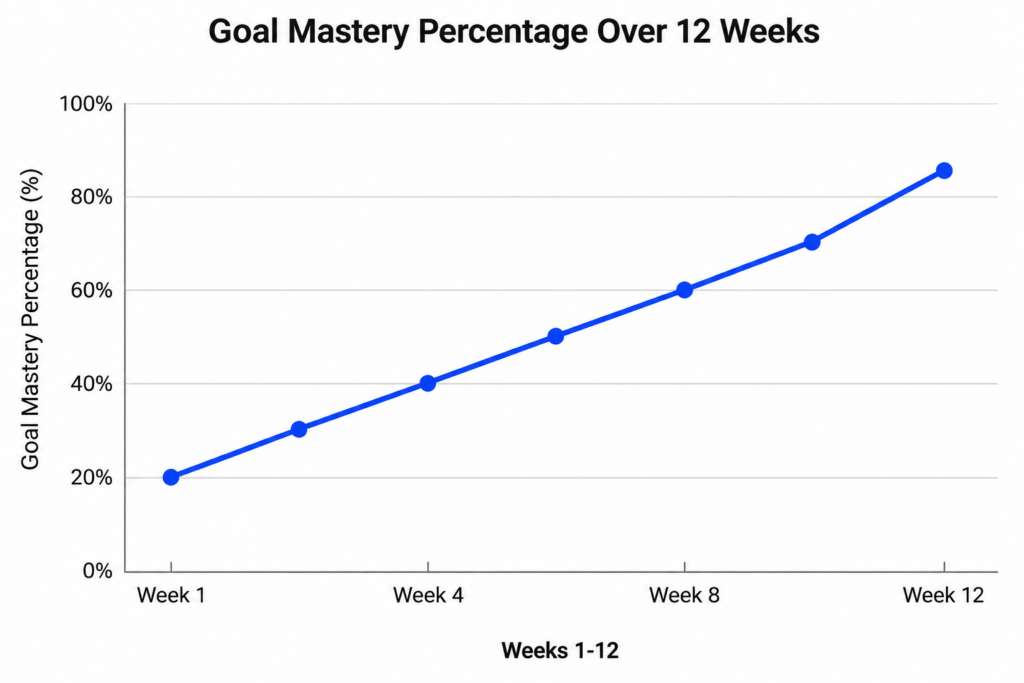
What should you expect in the first few months? Most families see small but meaningful changes within the first three to six months: a child who rarely made eye contact now looks at you when you call their name. A child who screamed for snacks now points or uses a single word. A child who refused to sit now tolerates five minutes of structured activity. These aren’t dramatic transformations, but they’re data points on an upward trend.
By 12 to 18 months of consistent therapy, many families report more noticeable shifts: expanded vocabulary, reduced tantrum frequency, new self-care skills, improved play with peers. By two to three years, children often show gains that generalize across settings (home, school, community), and some transition to lower-intensity services or school-based support.
But ABA isn’t a cure, and it’s not a race. The goal is meaningful, individualized progress that improves your child’s quality of life and your family’s daily functioning. Some children will always need support. Some will “graduate” from ABA and thrive independently. The trajectory is unique to each child.
For a realistic picture of what families can expect over time, the benefits families can expect from ABA therapy breaks down the research and real-world outcomes in greater depth.
Common Questions Parents Ask About the ABA Process
Will My Child Sit at a Table All Day?
No. Modern ABA is play-based, flexible, and responsive to your child’s needs. While some structured table work (discrete trial training) may be part of the program, especially for foundational skills like matching or following instructions, most learning happens on the floor, at the park, in the kitchen, or wherever your child’s interests lead. Sessions include sensory breaks, outdoor time, and community outings. The goal is to teach skills your child can use in the real world, not just perform in a clinic room.
What If My Child Doesn’t Like Their RBT?
Rapport matters. At Arizona Autism Clinic, we use a True 1:1 model, meaning your child works with the same dedicated RBT session after session. This consistency builds trust and accelerates learning. But if the pairing isn’t working (personality mismatch, your child isn’t engaging, you have concerns), speak up. The BCBA can adjust the pairing or coach the RBT on strategies to improve rapport. Your input is valued.
Does ABA Replace Speech Therapy or Occupational Therapy?
No. ABA, speech therapy (SLP), and occupational therapy (OT) are complementary, not competing. ABA focuses on behavior, communication, and skill acquisition through applied behavior principles. SLP focuses on language mechanics (articulation, pragmatics, receptive/expressive language). OT focuses on sensory processing, fine motor skills, and self-care. Many children receive all three therapies simultaneously, and the best programs coordinate across disciplines. Your BCBA, SLP, and OT should talk to each other and align goals.
Will My Insurance Cover ABA Therapy?
Most private insurance plans and Arizona Medicaid (AHCCCS) cover ABA therapy for children with an autism diagnosis. Coverage varies by plan, but many families receive 20 to 40 hours per week of therapy with little to no out-of-pocket cost. The BCBA will help you navigate the authorization process, submit treatment plans to insurance, and coordinate approvals. Arizona state law mandates autism coverage under most plans, so access is broader here than in many states.
Ready to See How ABA Can Work for Your Child?
ABA therapy isn’t a black box. It’s a transparent, structured, individualized process built on decades of research and refined through real-world practice with thousands of families. From the first BCBA assessment to the daily data tracking to the ongoing partnership with your family, every step is designed to help your child learn, grow, and thrive.
You now understand how ABA therapy works: individualized goals, play-based teaching, continuous BCBA oversight, daily progress updates, and genuine collaboration with your family at every turn. At Arizona Autism Clinic, we deliver this process with True 1:1 care, meaning your child never shares their RBT’s attention with another client. Every session is theirs. Every goal is tailored. Every adjustment is data-informed.
We serve families across the East Valley and White Mountains, including our Apache Junction clinic and our Lakeside-Pinetop location, bringing high-quality ABA therapy to communities where access has historically been limited. Families across Mesa, Gilbert, Chandler, and the East Valley trust us to deliver individualized, evidence-based care close to home.
If you’re ready to see how a BCBA-led, True 1:1 ABA program can support your child’s growth, we’re here to help. Arizona Autism Clinic partners with families at every step, providing individualized therapy, daily progress tracking, and genuine partnership from assessment through ongoing care.
Start your application today to schedule your child’s initial BCBA assessment. Our team is ready to answer your questions, explain the process, and help you take the first step toward meaningful progress.
For more resources on autism, ABA therapy, and family support, explore more autism resources for Arizona families on our blog.