
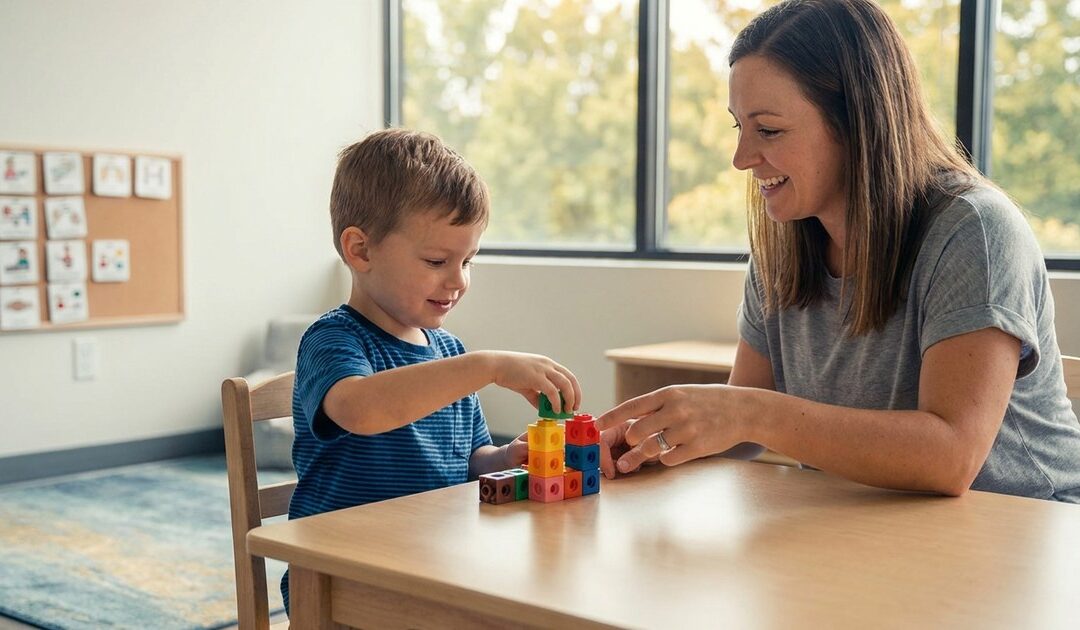
If you’re new to ABA therapy, you’re probably wondering whether it will truly help your child and what the journey will look like. You’ve heard the acronyms (BCBA, RBT, FBA) from your pediatrician or diagnostician, and maybe you’re comparing Arizona providers online, trying to make sense of clinical jargon while managing the worry every parent feels after a diagnosis. You want to know if this approach can help your child communicate, make friends, and thrive at school. The answer: ABA therapy helps children with autism develop communication, social, self-care, and emotional regulation skills through individualized, evidence-based programs. BCBA-supervised sessions use positive reinforcement and data tracking to teach meaningful skills, reduce challenging behaviors, and support independence at home, school, and in the community. Outcomes vary by child, but research shows consistent gains when therapy is personalized, intensive, and family-involved.
This guide walks through what ABA therapy does, how it works from assessment to progress tracking, what the research shows, and what Arizona families should expect: timelines, therapy intensity, and how to choose a provider. You’ll also learn why individualized ABA therapy across Arizona prioritizes family partnership, BCBA oversight, and true 1:1 care.
By Arizona Autism Clinic
What ABA Therapy Does: Core Benefits for Children with Autism
ABA (Applied Behavior Analysis) therapy targets meaningful skill development across five core domains: communication, social interaction, daily living, emotional regulation, and behavior reduction. Every program is individualized by a Board Certified Behavior Analyst (BCBA), a master’s-level clinician who designs goals based on each child’s unique starting skills, family priorities, and real-world needs. According to the Autism Science Foundation’s position statement, ABA is the most researched and evidence-based intervention for autism, with decades of peer-reviewed studies supporting its effectiveness when programs are individualized and family-involved. Outcomes depend on the child’s baseline skills, therapy intensity (measured in hours per week), and how consistently families practice strategies at home. No program is cookie-cutter, and no two children progress at the same pace, but the skills ABA teaches are the building blocks for independence and participation in school, home routines, and community life.
For families exploring ABA therapy in Arizona, understanding what the therapy addresses helps set realistic expectations. Let’s break down each skill domain.
Communication and Language Development
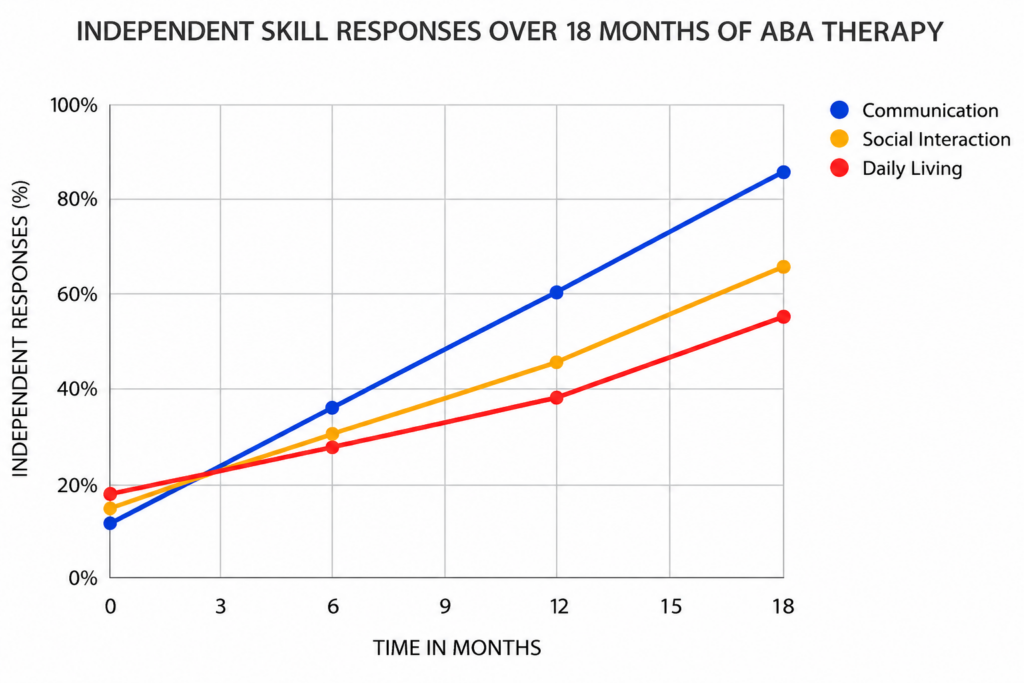
ABA therapy teaches both expressive language (what a child says or communicates) and receptive language (what a child understands). For a preschooler who doesn’t yet use words, that might mean learning to request a snack by pointing to a picture card, signing “more,” or approximating the word “cookie” instead of crying or pulling an adult’s hand. For a school-age child with emerging language, therapy targets conversational turn-taking, answering “wh-” questions (who, what, where), and expanding sentence length. When spoken language isn’t accessible, BCBAs integrate augmentative and alternative communication (AAC) devices or picture exchange systems so every child has a way to express their needs, preferences, and ideas. These communication skills reduce frustration, increase participation in classroom and family activities, and lay the foundation for social connection.
Social Skills and Peer Interaction
ABA therapy explicitly teaches the social behaviors that many children with autism find challenging: joint attention (noticing what someone else is looking at or doing), sharing and turn-taking during play, initiating conversations, and understanding nonverbal cues like facial expressions or body language. Sessions practice these skills through structured play, role-playing, and coached peer interactions. A technician might model how to invite a sibling to play, prompt the child to offer a toy, and reinforce the child when they wait for their turn. The goal isn’t just to perform the skill in the clinic: it’s to generalize it to school recess, playdates, and family gatherings. BCBAs collaborate with parents and teachers to ensure skills transfer across settings, so a child who learns to greet a peer in therapy also greets classmates at circle time.
Daily Living and Independence Skills
Self-care routines (dressing, toileting, eating with utensils, brushing teeth) are explicit ABA therapy goals, especially for younger children and those with significant support needs. These skills reduce family stress (a child who can put on their shoes independently frees up a parent’s morning routine) and prepare children for school, daycare, and eventually adulthood. ABA uses task analysis (breaking a routine into small, teachable steps) and systematic prompting (hand-over-hand assistance that gradually fades) to teach each step until the child can complete the whole sequence. Beyond self-care, therapy targets household routines (clearing the table, following a visual schedule, transitioning between activities) and community safety (staying with a caregiver in a store, crossing the street, asking for help). These are the skills that make participation in daily life possible.
Emotional Regulation and Coping Strategies
Children with autism often experience intense emotions and struggle to manage frustration, sensory overload, or unexpected changes. ABA therapy teaches children to identify their own emotions (using visual supports like feeling charts or social stories), tolerate small frustrations without escalating, and use replacement coping strategies when they’re upset. Instead of a meltdown when a preferred toy is unavailable, a child learns to ask for help, take deep breaths, or choose a different activity. In our work with Arizona families, we’ve found that progress accelerates when parents practice ABA strategies at home: consistent reinforcement across settings makes skills stick. At Arizona Autism Clinic, sensory regulation is integrated into every session (not treated as a separate service), so BCBAs address sensory sensitivities (tactile defensiveness, auditory overload, proprioceptive seeking) as part of the individualized plan, not as an afterthought.
Reducing Challenging Behaviors Through Function-Based Intervention
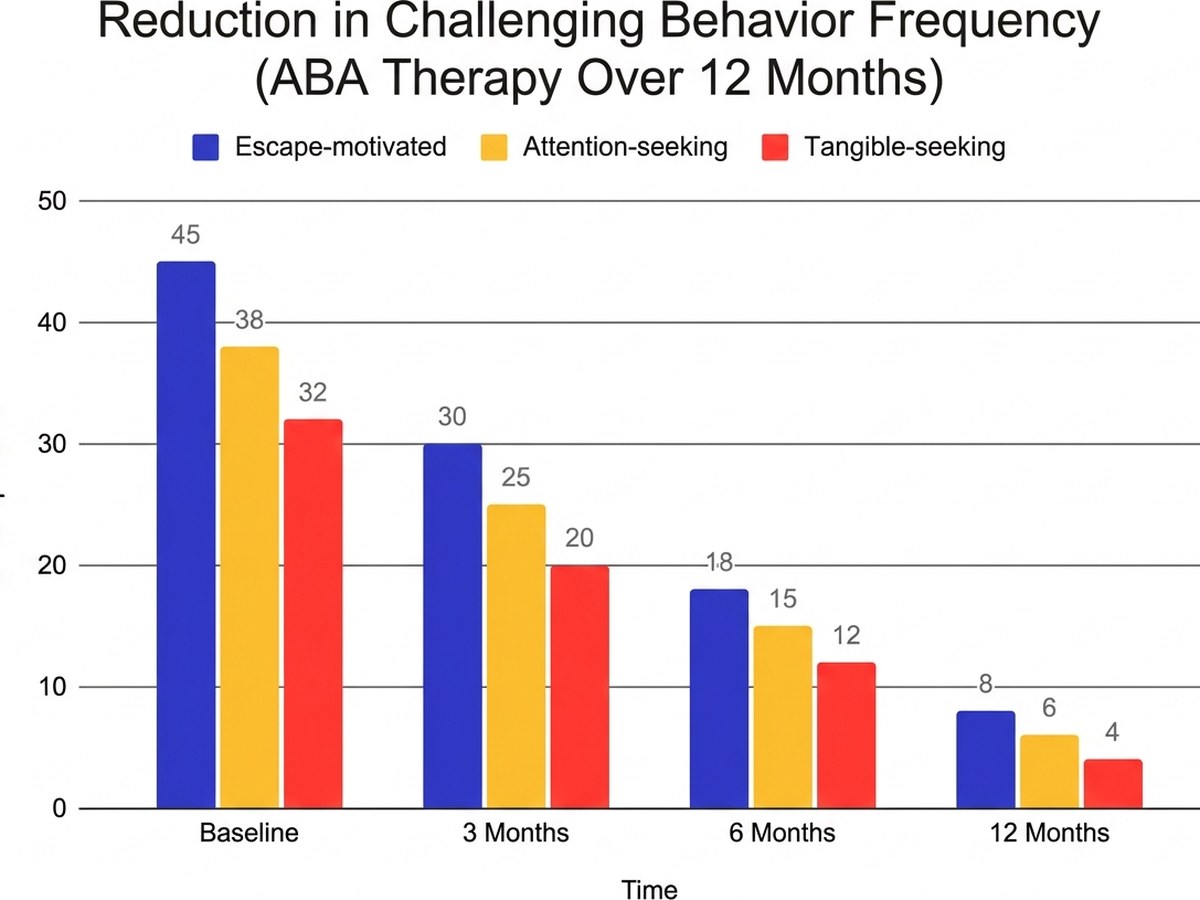
When a child engages in challenging behavior (tantrums, aggression, self-injury, elopement), ABA doesn’t punish or suppress the behavior. It identifies the function (the reason the behavior works for the child). Is the child escaping a difficult task? Seeking attention? Accessing a preferred item? Meeting a sensory need? A BCBA conducts a Functional Behavior Assessment (FBA) to determine the function, then designs a function-based intervention: teaching a replacement skill that serves the same purpose but is socially appropriate. If a child bites to escape a demand, the BCBA teaches the child to request a break using a picture card or sign. If a child yells to get attention, the BCBA teaches the child to tap an adult’s shoulder and wait. The behavior decreases because the child has a better tool, not because they’ve been punished. This is why ABA practitioners say, “We teach what to do, not just what not to do.”
How ABA Therapy Works: The Process from Assessment to Progress
Understanding the clinical workflow helps demystify ABA therapy for parents who worry it will feel rigid or impersonal. Every ABA program at Arizona Autism Clinic is BCBA-directed and data-driven, but never cookie-cutter. Here’s what the process looks like from intake to ongoing therapy.
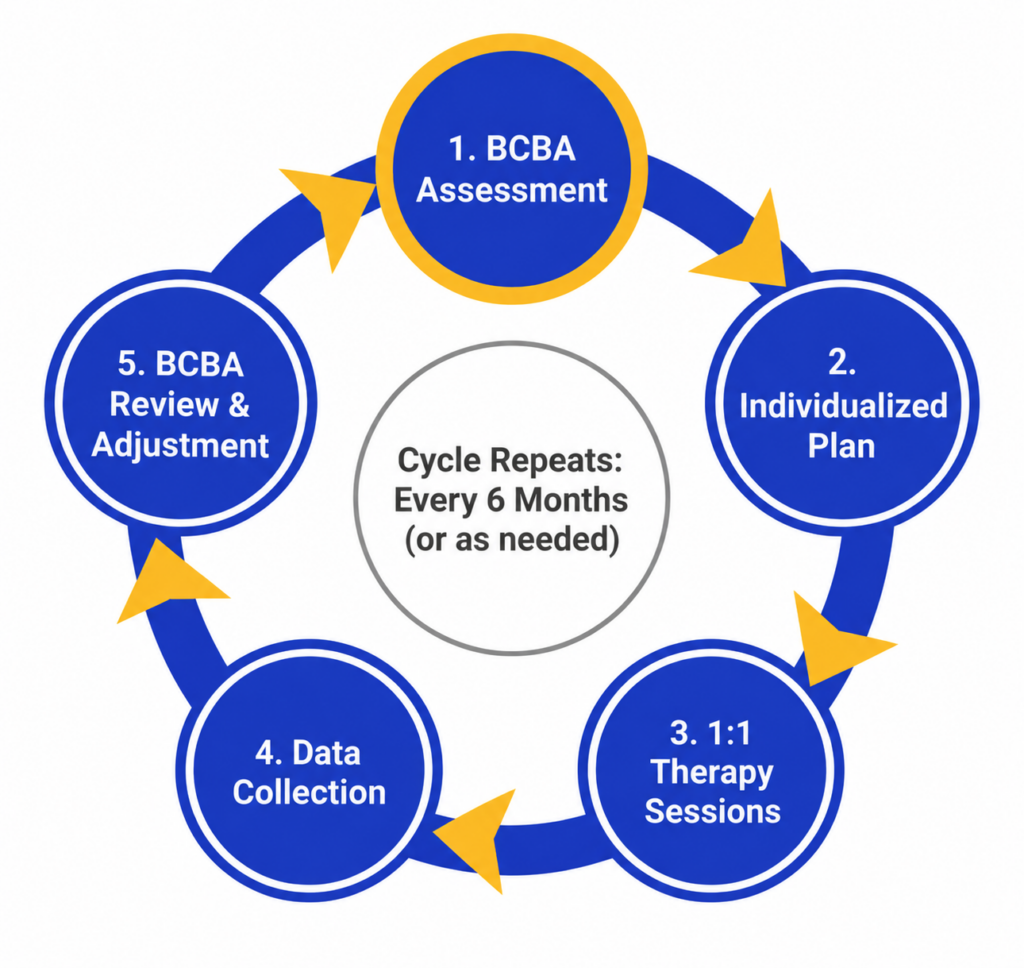
Initial BCBA Assessment and Goal Setting
The first step is a comprehensive assessment conducted by a BCBA. This isn’t a one-hour observation: it’s a multi-session evaluation that includes direct interaction with your child, parent interviews, review of prior evaluations (speech, occupational therapy, school IEP), and observation in natural settings (home, school, or community). The BCBA assesses current skills across communication, social interaction, play, self-care, and behavior using standardized tools (VB-MAPP, ABLLS-R, or similar). They also conduct a Functional Behavior Assessment (FBA) if challenging behaviors are present, identifying what triggers the behavior and what function it serves. Parents are active collaborators in this phase. You identify priorities (“I want my child to sleep through the night,” “I want them to play with their sibling,” “I want them to tolerate haircuts”) and the BCBA translates those family goals into measurable, teachable objectives. If you’re curious about what a BCBA does in ABA therapy, the assessment phase is where their clinical training becomes operational. They’re not just implementing a manual; they’re designing a plan unique to your child.
Individualized Treatment Plans (No Cookie-Cutter Programs)
After the assessment, the BCBA writes an individualized treatment plan that maps every goal, teaching procedure, data-collection method, and reinforcement strategy. This plan is submitted to your insurance for authorization (most Arizona health plans cover ABA under the state’s autism mandate), and it’s updated every six months or whenever your child’s needs change. The plan specifies which skills will be taught (requesting, labeling, turn-taking, dressing, emotional identification), which teaching methods will be used (discrete trial training for structured learning, natural environment teaching for play-based practice, incidental teaching for spontaneous communication), and how progress will be measured (percentage of independent responses, frequency of challenging behaviors, duration of on-task engagement). No two plans are identical. A preschooler with no verbal language will have a communication-heavy plan emphasizing manding (requesting) and joint attention. A school-age child with conversational speech will focus on social reciprocity, academic readiness, and self-regulation. A teen will target independence skills, job readiness, and community navigation. This individualization is what separates clinic-based ABA from templated online programs or unsupervised freelance models. Every decision is backed by data and guided by a BCBA’s clinical judgment.
True 1:1 Therapy Sessions with Dedicated RBT Support
Once the plan is approved, therapy begins. At Arizona Autism Clinic, every session is true 1:1 care: one Registered Behavior Technician (RBT) provides undivided attention to one child for the entire session. This isn’t shared care where a technician rotates between multiple children in a group room. It’s one-on-one, every minute. The RBT implements the BCBA’s plan, running teaching trials, collecting data on every response, and adjusting in the moment based on the child’s engagement and success rate. Sessions are active and varied (sometimes at a table working on sorting or matching, sometimes on the floor playing with toys to teach turn-taking, sometimes in the community: a grocery store, park, or library) practicing real-world skills. The RBT uses positive reinforcement (praise, preferred items, access to activities) to motivate learning and makes the session feel playful, not drill-based.
BCBA Supervision and Ongoing Program Adjustments
A common misconception is that ABA therapy is “just the technician.” In reality, the BCBA is the clinical architect, and ongoing supervision is what ensures quality. BCBAs observe sessions in person or via video, review daily data graphs, provide real-time feedback to RBTs, and adjust teaching procedures when progress stalls or accelerates. If a child masters a goal (labeling 20 objects independently), the BCBA writes a new, more complex goal (using those labels in sentences). If a child struggles with a goal (turn-taking during play), the BCBA troubleshoots: Is the reinforcement strong enough? Is the task too hard? Is the prompt fading too fast? Supervision also includes training RBTs on new procedures, modeling advanced techniques, and ensuring treatment fidelity (the plan is implemented as written, not improvised). For families with teens or young adults, this supervision extends into ABA programming for older learners, where BCBAs adapt goals to focus on vocational skills, community independence, and life-skills coaching. A 2024 study published in the Journal of Applied Behavior Analysis found that programs with consistent BCBA oversight produced significantly larger skill gains than unsupervised models, with effect sizes ranging from moderate to large depending on baseline skills and therapy intensity.
Daily Progress Tracking and Family Updates
Every ABA session generates data. RBTs record every trial (did the child respond independently, with a prompt, or incorrectly?), every behavior incident (what happened before, what the child did, what happened after), and every generalization probe (can the child use the skill in a new setting or with a new person?). This data is graphed daily and reviewed by the BCBA, who shares summaries with families weekly or biweekly. You’ll see trend lines showing skill acquisition over time, behavior reduction over weeks, and goal mastery percentages. This transparency builds trust. You’re not guessing whether therapy is working; you’re reading the evidence. Parents also receive regular progress reports (quarterly or every six months) that compare current performance to baseline and outline next steps. Families consistently cite “feeling heard” and “understanding the data” as top reasons they trust the process. Transparency builds partnership.
Does ABA Therapy Work? What the Research Shows
If you’re wondering whether the benefits of ABA therapy deliver real outcomes, you’re asking the right question. Autism Speaks defines ABA as a therapy rooted in learning science that uses positive reinforcement and data tracking to teach communication, social, and daily-living skills one step at a time. But does it work?
The evidence base is strong. ABA is the most researched autism intervention, with over 50 years of peer-reviewed studies documenting ABA effectiveness. The Autism Science Foundation affirms that ABA therapy is the most researched and evidence-based intervention for autism, with decades of peer-reviewed studies supporting its effectiveness when programs are individualized and family-involved. Major medical bodies (the American Academy of Pediatrics, the U.S. Surgeon General, and autism research organizations) endorse ABA as a recommended treatment. Landmark studies, including Lovaas (1987) and meta-analyses by Virués-Ortega (2010), show that early, intensive behavioral intervention (25+ hours per week, started before age 5) produces significant gains in IQ, language, and adaptive behavior, with some children moving from high-support to mainstream classroom placements.
Effect sizes vary. Not every child makes the same gains, and no ethical provider guarantees specific ABA therapy outcomes. Effectiveness depends on several factors: the child’s age when therapy starts (earlier is generally better), baseline skills (children with some language tend to progress faster in communication goals than those with none), therapy intensity (more hours per week typically correlates with larger gains), program quality (BCBA supervision, individualized plans, family involvement), and consistency (therapy that stops and starts or isn’t practiced at home yields smaller effects). A 2024 meta-analysis found that individualized ABA programs with continuous BCBA oversight produced moderate to large effect sizes in communication, social behavior, and adaptive functioning, with the strongest outcomes in children who started before age 4 and received 20+ hours per week.
The research also shows that family involvement amplifies ABA therapy outcomes. When parents learn to use ABA strategies at home (prompting, reinforcing, fading support), skills generalize faster and maintain longer. This is why Arizona Autism Clinic includes parent coaching, sibling workshops, and parent support as core offerings, not optional add-ons.
What to Expect: Timeline, Intensity, and Realistic Outcomes
Setting realistic expectations helps families stay committed during the early months, when progress can feel slow. ABA therapy is incremental. You won’t see overnight transformations, but you will see steady skill-building if the program is well-designed and consistently implemented.
Recommended Therapy Hours and Intensity
BCBA recommendations for therapy hours vary widely based on the child’s age, current skills, goals, and insurance authorization. Some children receive 10–15 hours per week (focused intervention targeting a few high-priority skills), while others receive 25–40 hours per week (comprehensive programming addressing communication, social, behavior, and daily living across multiple settings). Intensive programs (25+ hours) tend to produce faster and more generalized gains, but they’re not always feasible or necessary for every child. A school-age child with strong language skills and mild behavioral challenges might thrive with 15 hours focused on social reciprocity and emotional regulation. A preschooler with minimal communication and high-frequency challenging behaviors might need 30+ hours to make meaningful progress. Your BCBA recommends hours based on clinical need, and your insurance plan authorizes a specific number of hours per week (Arizona’s autism insurance mandate requires coverage, but cost-share and prior-authorization requirements vary by plan). During intake, families verify coverage and discuss what’s realistic for the family’s schedule. Therapy works best when it fits into your life, not when it overwhelms it.
When Families Typically See Progress
Most families notice small, encouraging changes within the first 3–6 months: increased eye contact, first word approximations, longer periods of on-task engagement, fewer daily meltdowns. These early wins are motivating, but they’re not the finish line. They’re the foundation. Meaningful skill mastery (conversational speech, independent toileting, safe community navigation, sustained peer play) takes 12–24 months or longer, depending on the complexity of the goal and the child’s starting point. Our BCBAs report that children who start ABA before age 5 and receive 20+ hours per week show measurable communication gains within 6–9 months, though timelines vary by baseline skills. Progress isn’t linear. Some months show rapid growth, others plateau while the BCBA adjusts strategies. This is normal. Data tracking helps families see the cumulative trajectory, not just the week-to-week variation.
The Role of Generalization (Home, School, Community)
A skill learned in the clinic only matters if it transfers to real life. Generalization (the ability to use a skill in new settings, with new people, and with new materials) is the ultimate measure of ABA’s effectiveness. A child who labels objects at the therapy table but doesn’t request a drink at home hasn’t fully acquired the skill. BCBAs build generalization into every program by varying teaching conditions (different rooms, different technicians, different toys), conducting community outings (grocery stores, parks, restaurants), and training parents to prompt and reinforce skills at home. For example, if a child is learning to greet peers, the RBT practices in the clinic, the BCBA coaches the parent to prompt greetings at the playground, and the teacher reinforces greetings at school drop-off. This cross-setting collaboration is why family partnership and school collaboration are non-negotiable components of high-quality ABA.
Why Family Involvement Makes ABA More Effective
ABA therapy isn’t something that happens to your child while you wait in the lobby. It’s a partnership. Families who actively participate in therapy (observing sessions, practicing strategies at home, attending parent training, and communicating regularly with the BCBA) see faster, more durable progress than families who treat therapy as a drop-off service.
Parent Coaching and Home Practice
BCBAs and RBTs train parents to use ABA strategies at home so skills practiced in the clinic generalize to daily routines. A parent might learn how to prompt their child to request a preferred snack (instead of grabbing or crying), how to reinforce independent dressing with praise and a sticker chart, or how to use a visual schedule to ease transitions between activities. This training happens during scheduled coaching sessions, during observations of therapy, and through video modeling or written guides. When parents apply these strategies consistently (prompting, reinforcing, fading support), the child practices skills dozens of times per day instead of only during therapy hours. The research is clear: home practice accelerates progress. For families exploring what to ask before you enroll, confirm that parent coaching is included in the program, not charged as an add-on.
Sibling Workshops and Family Support
Arizona Autism Clinic offers sibling workshops and parent support as core services, not extras. Sibling workshops help brothers and sisters understand why their sibling receives therapy, teach them how to play cooperatively using ABA-informed strategies (prompting, turn-taking, reinforcing), and give them space to share their own feelings about having a sibling with autism. Parent support connects families navigating similar challenges (sleep issues, school advocacy, insurance denials, therapy burnout) and provides peer support, resource sharing, and validation. These offerings reduce caregiver stress and help the whole family engage in the child’s progress, not just the parent who attends sessions.
Daily Progress Updates and Transparent Communication
Transparency builds trust. Parents receive regular data summaries showing what goals were targeted, how the child performed, what strategies worked, and what the BCBA adjusted. Some providers send daily session notes; others share weekly graphs and biweekly phone check-ins. You can observe sessions in person or via video (with proper consent and privacy protections) to see exactly what therapy looks like. This openness demystifies ABA, reduces parental anxiety (“Is my child just playing, or is this actually therapy?”), and keeps families engaged in goal-setting. When a parent understands why the BCBA added a new reinforcer or changed a prompt sequence, they can replicate those strategies at home.
Choosing the Right ABA Provider in Arizona: What to Ask
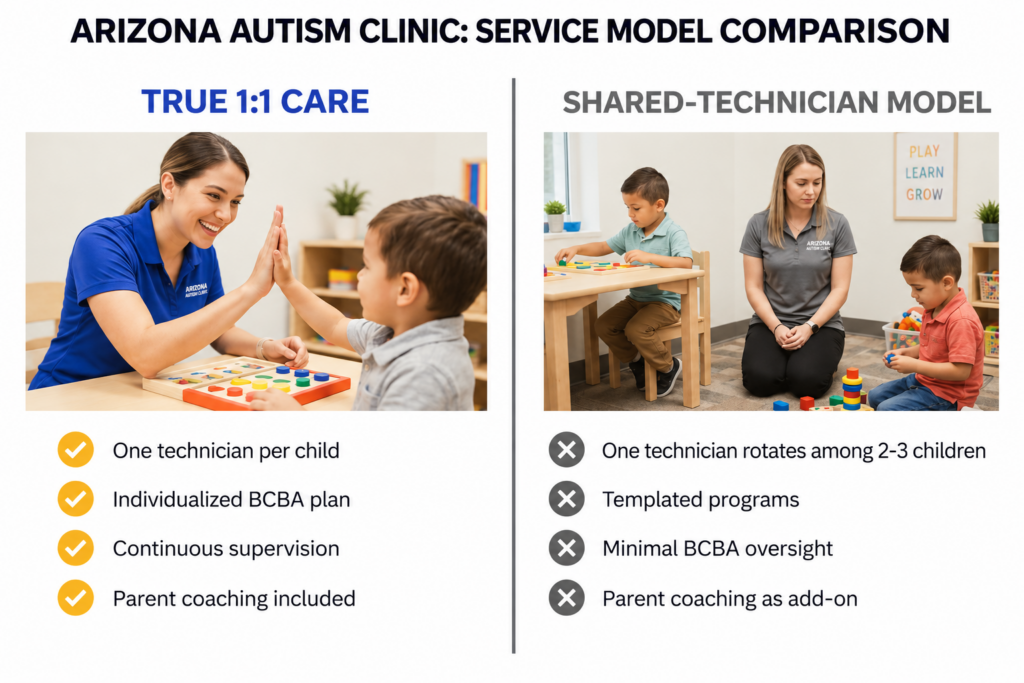
Not all ABA providers are created equal. Some offer true 1:1 care with continuous BCBA supervision and parent coaching; others use shared-technician models, templated programs, or minimal oversight. Asking the right questions during intake helps you identify a provider aligned with your values and your child’s needs.
Key questions to ask:
- Does the provider offer true 1:1 care, or are technicians shared across multiple children? At Arizona Autism Clinic, every session is one technician, one child, full attention: no diluted care.
- Are treatment plans individualized by a BCBA, or templated? Every child’s program should be designed from scratch based on assessment data and family priorities, not pulled from a standard protocol.
- How often does the BCBA supervise and review progress? High-quality programs include weekly or biweekly BCBA observation, real-time feedback, and continuous data review.
- Does the clinic offer parent coaching, sibling support, and progress tracking as standard, or as add-ons? Family involvement should be built into the program, not charged separately.
- Is the clinic accessible to your Arizona community? Arizona Autism Clinic serves families across Mesa, Apache Junction, Gilbert, Chandler, and the East Valley, with additional locations in underserved markets like our Lakeside-Pinetop clinic in the White Mountains. Community presence matters: local providers understand the school districts, insurance landscape, and resources available to your family.
- What age ranges does the clinic serve? Some clinics only work with toddlers and preschoolers; others extend into the school years and adolescence. If your child is a teen, confirm the provider has experience with independence and vocational programming.
If you’re ready to explore individualized ABA therapy for your child, Arizona Autism Clinic is here to help. Our BCBA-led team serves families throughout Arizona with true 1:1 care, parent coaching, and transparent progress tracking. For more guidance on the ABA journey, explore our autism resources for Arizona families.
Frequently Asked Questions About ABA Therapy Benefits
Is ABA therapy covered by insurance in Arizona?
Yes, most Arizona health plans cover ABA therapy for autism under the state’s insurance mandate (A.R.S. § 20-826.04), which requires insurers to provide medically necessary autism services, including ABA. However, cost-share (deductible, copay, coinsurance) and prior-authorization requirements vary by plan. Some families pay nothing out-of-pocket after meeting their deductible; others have a copay per session. During intake, Arizona Autism Clinic verifies your insurance coverage, submits the BCBA’s treatment plan for authorization, and walks you through your financial responsibility before therapy begins. Never assume full coverage or zero cost: verify with your plan and the clinic during the intake process.
Can ABA therapy help older children and teens?
Absolutely. ABA isn’t just for toddlers. Many families don’t realize that ABA programming extends through adolescence and young adulthood. Teens and young adults benefit from ABA targeting independence skills (cooking, money management, job readiness, public transportation), social reciprocity (dating, friendships, conflict resolution), and self-advocacy (communicating needs, managing schedules, navigating community resources). Arizona Autism Clinic offers ABA programming for teens and young adults who are aging out of school services or preparing for post-secondary life. The teaching methods adapt (less table work, more community-based practice), but the core principles (individualized goals, data-driven adjustments, BCBA oversight) remain the same.
How is ABA different from speech or occupational therapy?
ABA is a behavioral intervention addressing skill acquisition and behavior reduction across all domains (communication, social, daily living, emotional regulation). Speech therapy targets specific communication modalities (articulation, fluency, pragmatics, AAC), and occupational therapy targets sensory processing, fine motor skills, and activities of daily living from a developmental framework. ABA doesn’t replace speech or OT: it often complements them. For example, a speech therapist might teach a child to produce the /k/ sound, while an ABA program teaches the child to request a cookie using that sound in natural contexts. Some skills overlap (requesting, turn-taking, sensory regulation), and many families receive all three therapies concurrently. Coordination among providers ensures the team works toward shared goals, not conflicting approaches.
What if my child has sensory sensitivities?
Sensory sensitivities are common in children with autism, and they don’t disqualify a child from ABA therapy. At Arizona Autism Clinic, sensory regulation is integrated into every session. BCBAs identify sensory triggers (loud noises, bright lights, tactile defensiveness, proprioceptive seeking) during assessment and build accommodations and teaching strategies into the individualized plan. For example, a child who seeks deep pressure might receive movement breaks with weighted vests or compression toys; a child who avoids certain textures might use desensitization protocols paired with high-value reinforcement. Sensory supports aren’t a separate service: they’re woven into daily therapy so every child can engage, learn, and progress.
Conclusion: Why Individualized, BCBA-Supervised ABA Therapy Works
ABA therapy helps children with autism build communication, social, daily-living, and emotional-regulation skills through individualized, evidence-based programs grounded in decades of research. The benefits of ABA therapy are real: peer-reviewed studies, major medical endorsements, and thousands of families’ lived experiences confirm it. But outcomes depend on program quality, not just the ABA label. True 1:1 care, continuous BCBA supervision, family partnership, and individualized treatment plans separate high-quality providers from templated, unsupervised models.
If you’re an Arizona family navigating a new autism diagnosis or seeking better support for your child, you deserve a provider who sees your child as unique, involves you as a partner, and tracks progress with transparency. Arizona Autism Clinic delivers individualized ABA therapy with true 1:1 technician pairing, BCBA-led programming, parent coaching, and sibling support across the East Valley and White Mountains. We don’t offer cookie-cutter plans or shared care: we offer programs built around your child and your family’s priorities.